
ATP
Push it, Push it, to the Limit, Limit!
What is crime? Who are the criminals?- Batman, Batman Year: 100,
by Paul Pope
Chris Burden was shot was shot by Bruce Dunlap in front of a small crowd. Bruce Dunlap was not arrested. Chris Burden would be arrested later. Chris Burden was not shot in self-defense. He was shot for art. This performance was entitled Shoot.
Burden graduated from the University of California, Irvine, with a B.A. in visual arts, but much of his early, name making work, was less interested in capturing a moment in time, and more interested in creating a moment worth capturing. Prior to his bullet wound, the artist trapped himself in a campus locker for five days for his M.F.A. thesis. The university’s faculty and security staff debated ending his performance throughout the span of the week and conceded on its completion. That same year, 1971, Shoot was recorded on film and and photographed, but Burden was neither the photographer, nor the cinematographer for this event, serving as the piece’s subject and victim.
When interviewed about the piece, Burden has said that it was in conversation with news footage from the Vietnam War. “You saw a lot of people getting shot on TV every night. Guys my age,” relayed the wounded man in an interview for Shot in the Name of Art, a short documentary produced for The New York Times. I don’t doubt the sincerity of his intentions, but I do wonder what else this piece is in conversation with. Vietnam cast a shadow over American foreign policy for decades, but in the art world, this performance occurred only three years after Andy Warhol was shot by Valerie Solanos. Four years prior to that, in 1964, Dorothy Podbear shot a stack of Warhol’s silk screened Marilyn Monroe prints. These prints have sold for exorbitant prices because of their ballistic damage rather than in spite of it. Most recently, my former employer, Christie’s Auction House, sold Shot Sage Blue Marilyn for nearly $200 million, making it the most expensive piece of twentieth century art sold in a public sale.
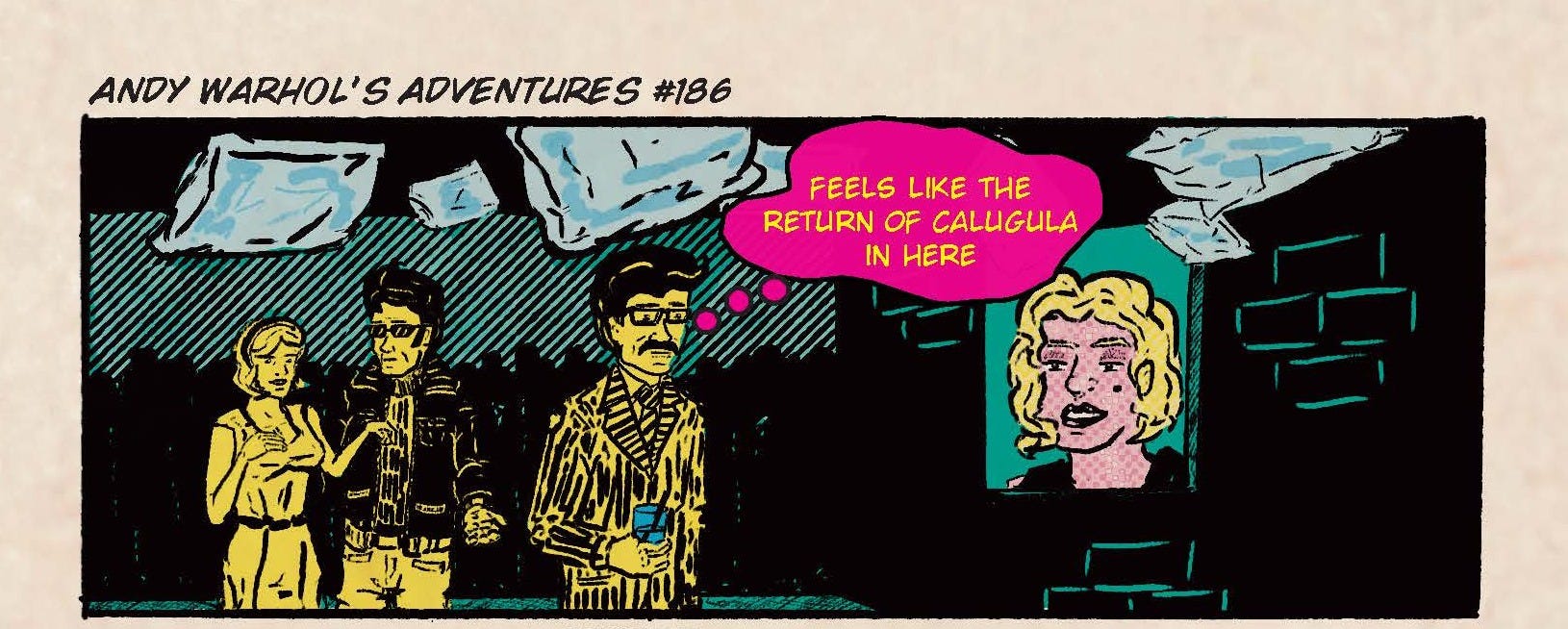
Blam. Instant gratification. At the squeeze of a trigger Burden assumes the roles of Warhol and the Shot Marilyns (crappy house band with this name pending). When I said, that Burden would later be arrested, it wouldn’t be for Shoot but for Deadman, a piece where the artist pretended to be a corpse in public and the authorities intervened for his obstruction of traffic. Not really a major crime, but it does make Burden the criminal, while Dunlap walked free, not that I would have wanted to see him punished. It’s just funny how that works.
Instant gratification has rooted itself deeply in the pleasure centers of those exposed to the internet. Interaction at the push of a button, and beyond interaction, commerce. If you’ve spent as little as one month on Twitter, you’ve probably noticed that there’s a never ending fight over the ethics of food delivery apps. It typically begins with one user positing that delivery is an essential service in a post-Covid world, or for the physically disabled, or with complaints about the application’s tipping system. This usually launches a moral crusade to prove that not tipping your Grubhub driver is tantamount to slavery as a result of the payment loopholes that the company subjects its employees to. I find it to be a bit of a no-win situation. I can tell you that from working in food service that the customer is usually wrong, and I don’t think that up-charged fast food is the only nutritional option for people bound to their home by disability, but there’s a little bit more muddying the waters here.
In the age of the expanding digital panopticon, verification of identity and citizenship have become more thorough, and as a result it has made finding work for illegal immigrants more difficult. In large cities, many of these people find employment through delivery applications, but not directly. A new age of middle-management has come to fruition, where legal residents create driver accounts and deploy those without documentation to perform the actual deliveries in their stead because this work won’t expose their status. No background check is required. I’m not writing about this because I’m worried a Door Dash bicyclist is going to poison my burrito in transit and sneak off without repercussion, but because the middle manager escapes the responsibility of providing regulated wages to their workers. I have to imagine that the payout dictated by the under the table managers turn the already miniscule pittance afforded for each delivery into the modern equivalent of indentured servitude. These middle managers are a new breed of criminal, and in the wake of our ongoing compliance the evolving technocracy that infects our daily routines, it seems they are one that will never face so much as a retributive class action lawsuit from the masses they exploit. Wage-thefts of the destitute .
Treatler, a portmanteau of “treat” and “Hitler” is a term that has risen to prominence in the online spheres to describe those who make ridiculous demands from their delivery service workers. It comes as not shock to me that in this era of fast-food related melt downs that reliance on Chat GPT, Midjourney, and other artificial intelligence programs has become so commonplace. While the first comics with AI Art, Prompt by Dave McKean and The Abolition of Man by Carson Grubaugh were produced as critical and analytical experiments examining the ways AI will impact comics, it has begun to trickle into the mainstream since the release of these projects. After fan outrage, DC Comics did not commit to publishing a series of variant covers from Francesco Mattina, following the accusations of his use of AI image generation, but has published projects that have left fans to wonder about the company’s scrutiny in these matters. Dan Panosian and Andrea Sorrentino faced similar accusations, but only after Panosion’s cover for Absolute Wonder Woman, and Sorrentino’s issue of Batman were both released. ATP by Michael Shea-Wright is a comic about work. It is not AI. The pages of this book feel like every bead of creative sweat that Shea-Wright has ever produced stain these interiors.
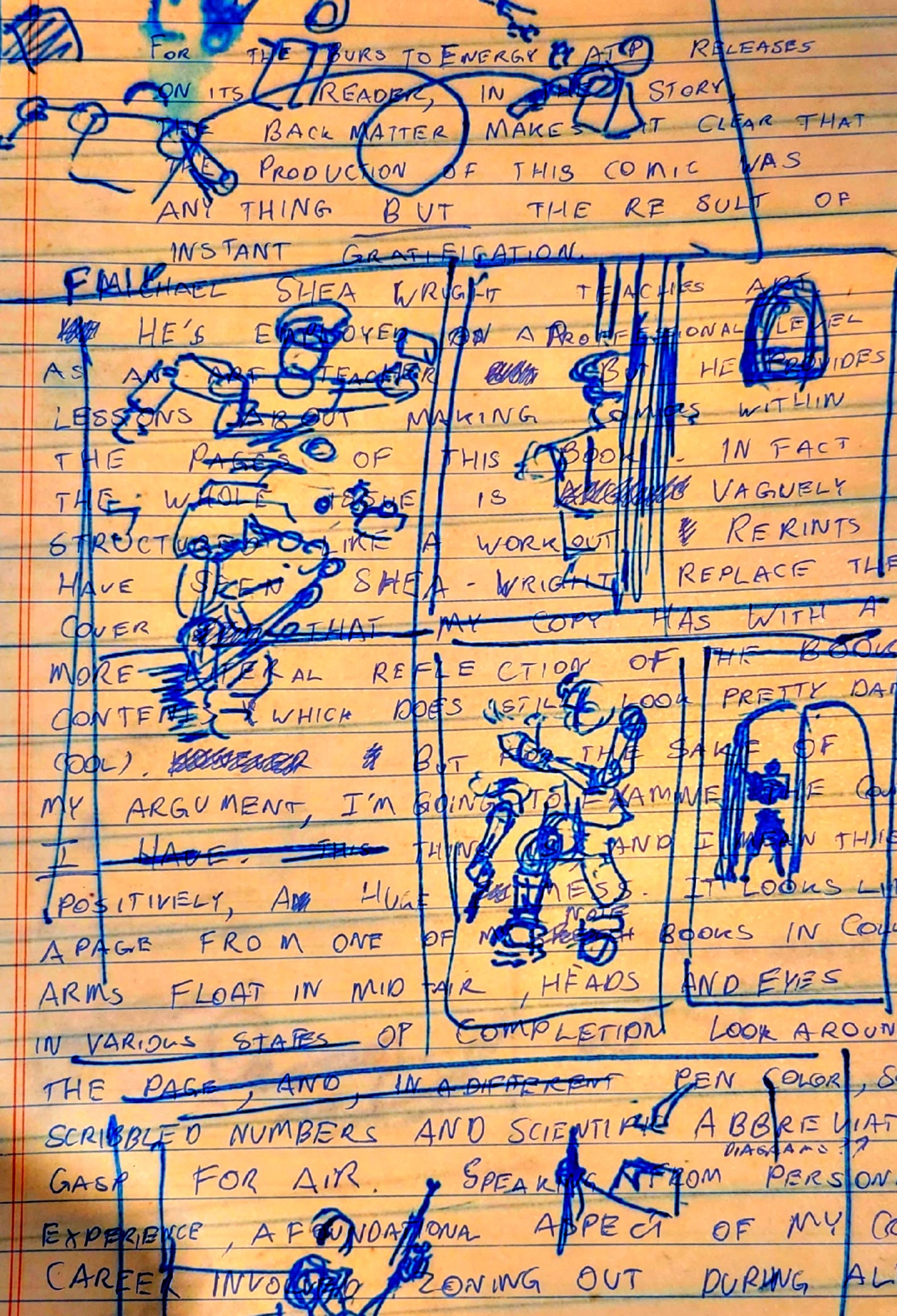
ATP is a rush. If you don’t remember your biology, it stands for adenosine triphosphate, and it’s required to get your cells to do just about anything. ATP is a rush; it is energy. Drawings bounce and weave, sweat glistens and dribbles. Bullets and punches fly like eagles. For the pure jolt that ATP presents in its story, the backmatter of this book makes it clear that the production of this comic was anything but the result of instantaneous gratification.
Michael She Wright teaches art. Professionally he’s an art teacher. He’s spoken about this in his interview with The Comics Journal. While ATP is not a ‘how to’ guide, the multi-pronged approach of its presentation makes it feel like a lesson. Shea Wright’s dynamic construction is not a droning lecture, but rather the opening remarks of a Socratic circle, which compels his audience not just to observe, but to participate. ATP is structured like a workout.
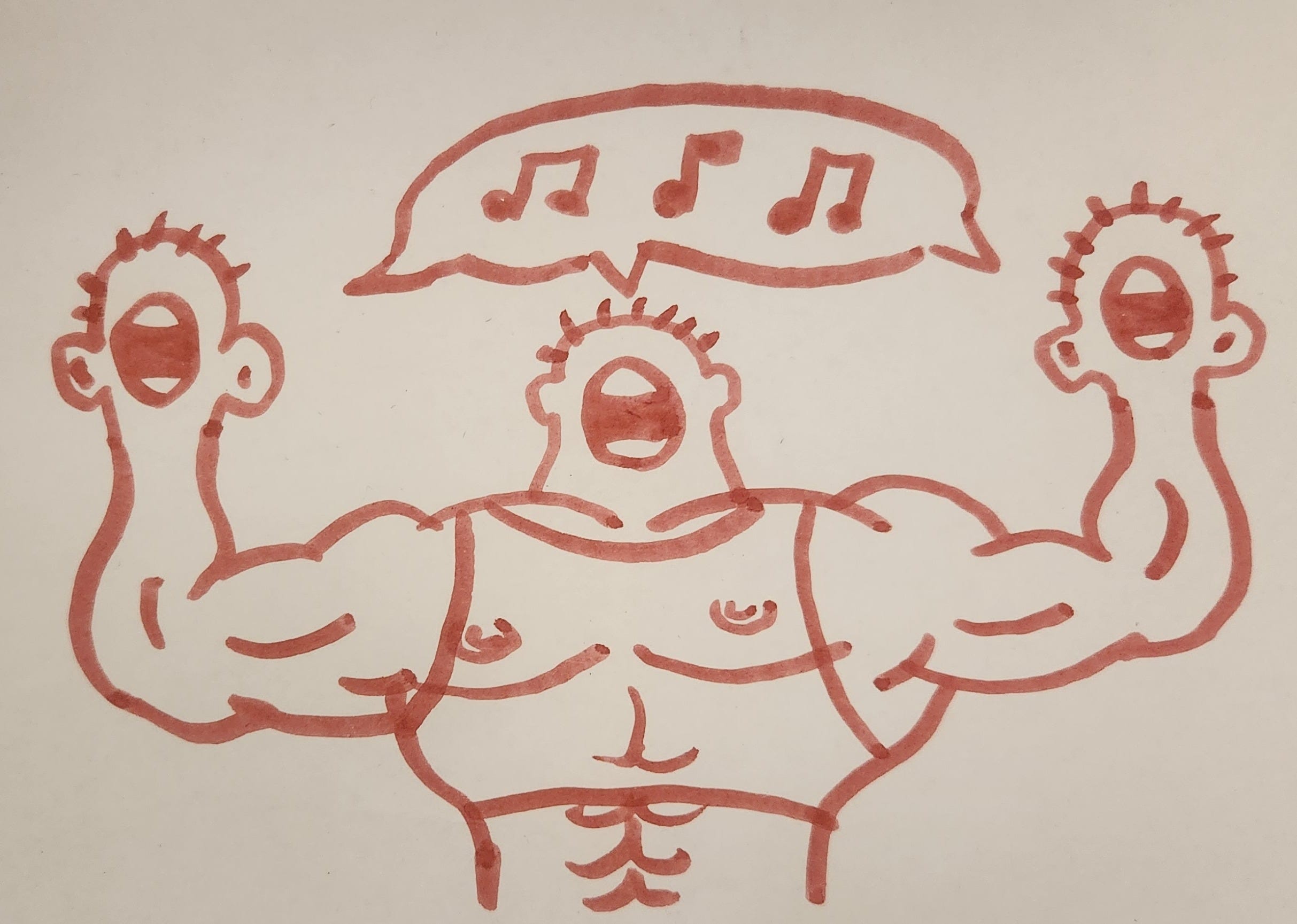
Reprints have seen Shea-Wright replace the cover that my copy has with a more literal reflection of the book’s contents (which does still look pretty damn cool), but for the sake of my argument I’m going to examine the cover in front of me. This image, and I mean this positively, is a huge mess. It looks like a page from one of my note books in college. Arms float in mid-air, heads and eyes drift around in various states of complete, and, in a different pen color scientific notes struggle to make themselves visible in the visual cacophony. Speaking from personal experience, a foundational aspect of learning to make comics involved zoning out during a lecture to work on thumbnails or character designs.
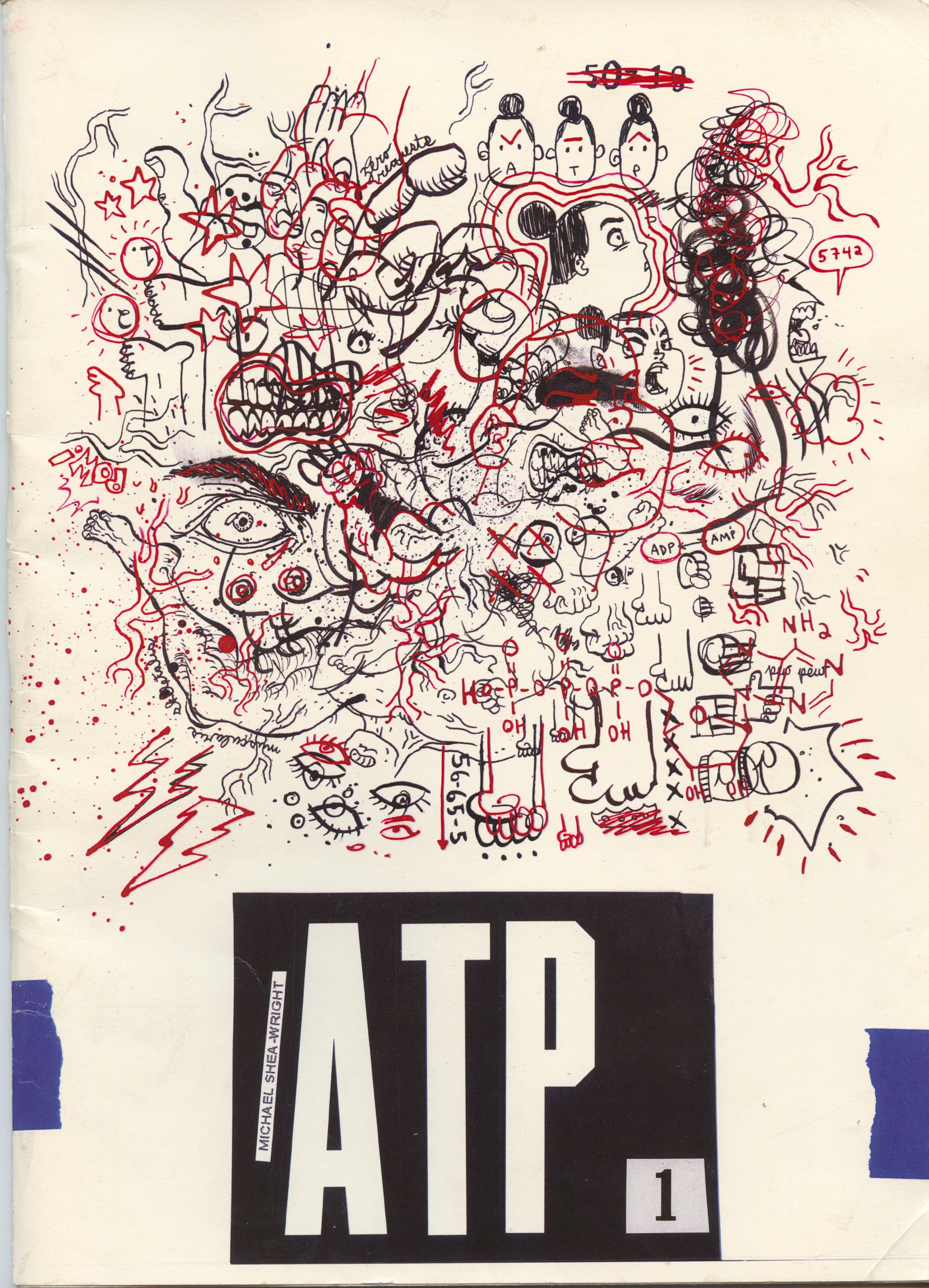
When Shea-Wright partially draws his character or puts two disembodied fists next to each other, it reads to me as someone doing stretches, the same way that my rough notebook drawings were the warm-up for me to attack the bristol board when I got home from class. Two images of ripped, blue, grip tape mark the left and right edges of the front cover. These do double duty, noting the DIY-ness of this comic and providing a visual cue for some of the story’s work-out elements.
The inside front cover features a scuffle in four moments. While these are as confidently drawn as the rest of the interior of the book, the absence of faces and panel borders, as well as the fluid posture of the characters, and it’s narrative irrelevance to the pages that follow make this feel like more stretching.
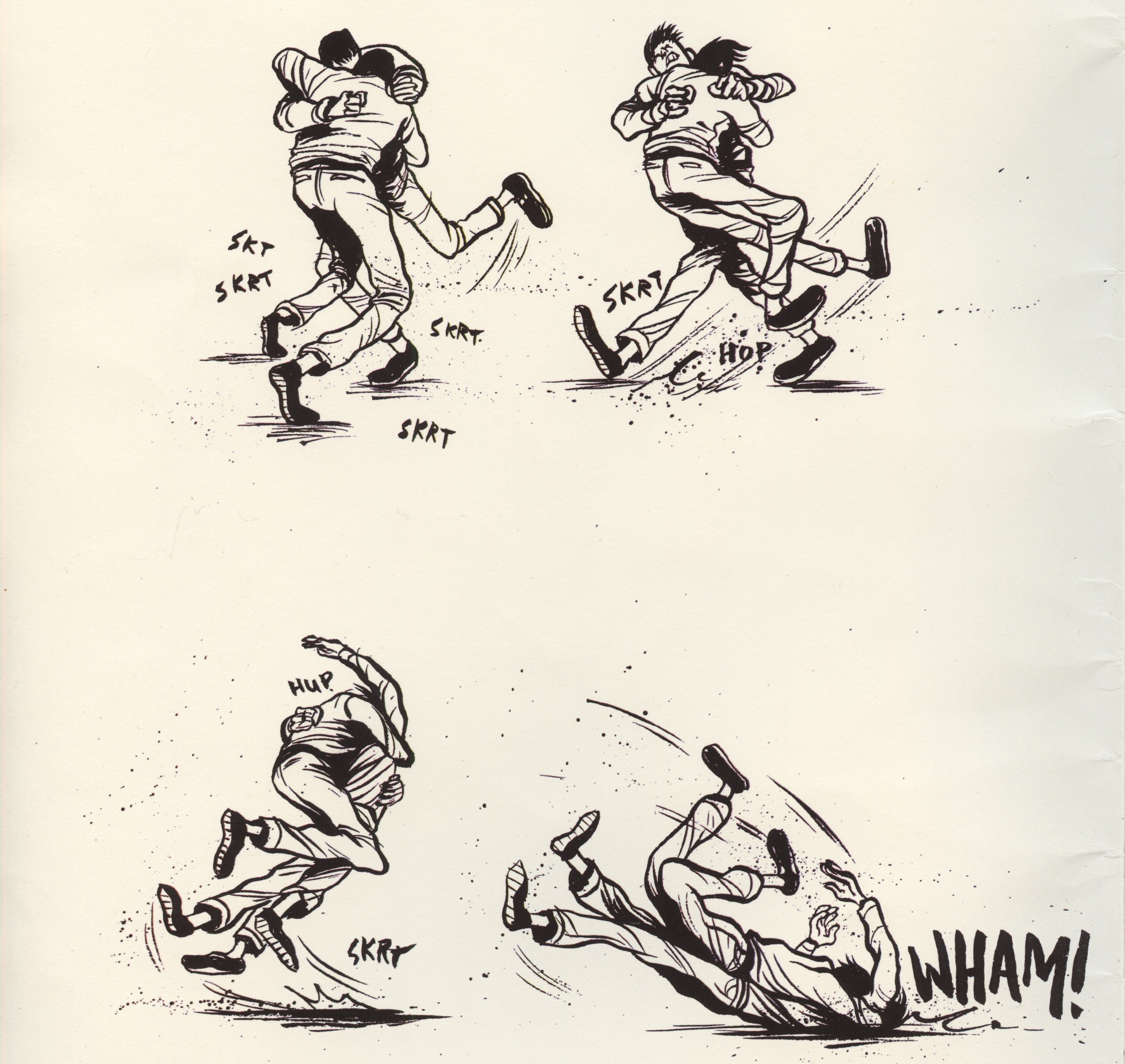
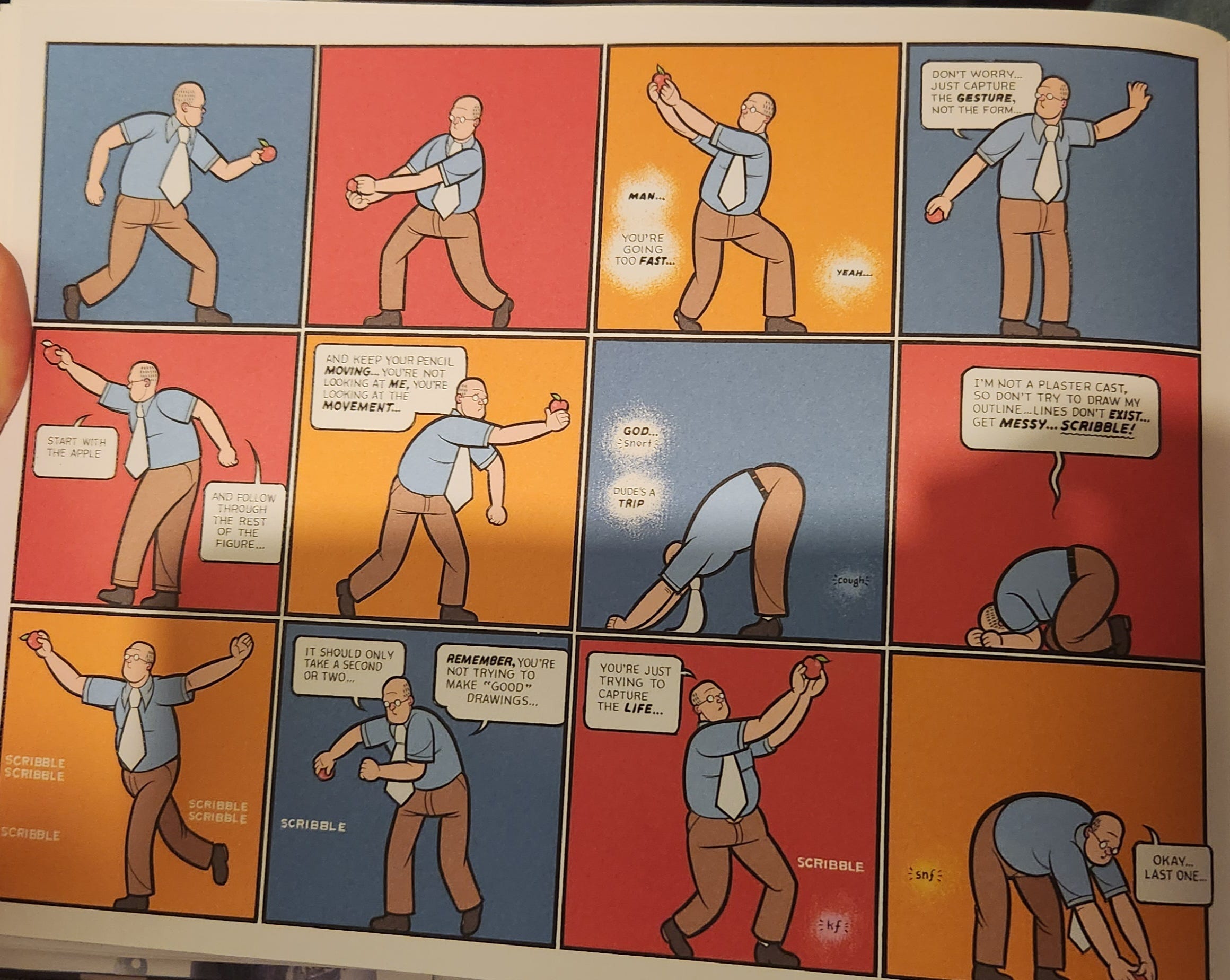
Compare the way these two move while they wrestle to Chris Ware’s character in Rusty Brown asking his class to get into the zone by doing some rapid gesture drawings. This is one last set of warm-up exercises before the real punishment begins.
Page one gives us a nearly full view of Jeffery Cavendish, who will be one of the book’s two leads from the front and back as he views his body critically in his bedroom mirror. He pops a boner while flexing in front of the glass and closes the door, presumably to masturbate. Hey, it’s crass, it’s memorable, and it does set up Cavendish as both self-obsessed and a man who wants to release a little adrenaline, which will become more apparent as the issue continues.
Elsewhere in the apartment Cavendish’s wife sips her coffee as their son complains to her about a stomach ache. On the kitchen table, Jeffery’s phone keeps buzzing. Jeffery enters the room and greets his family before checking the messages he just received.
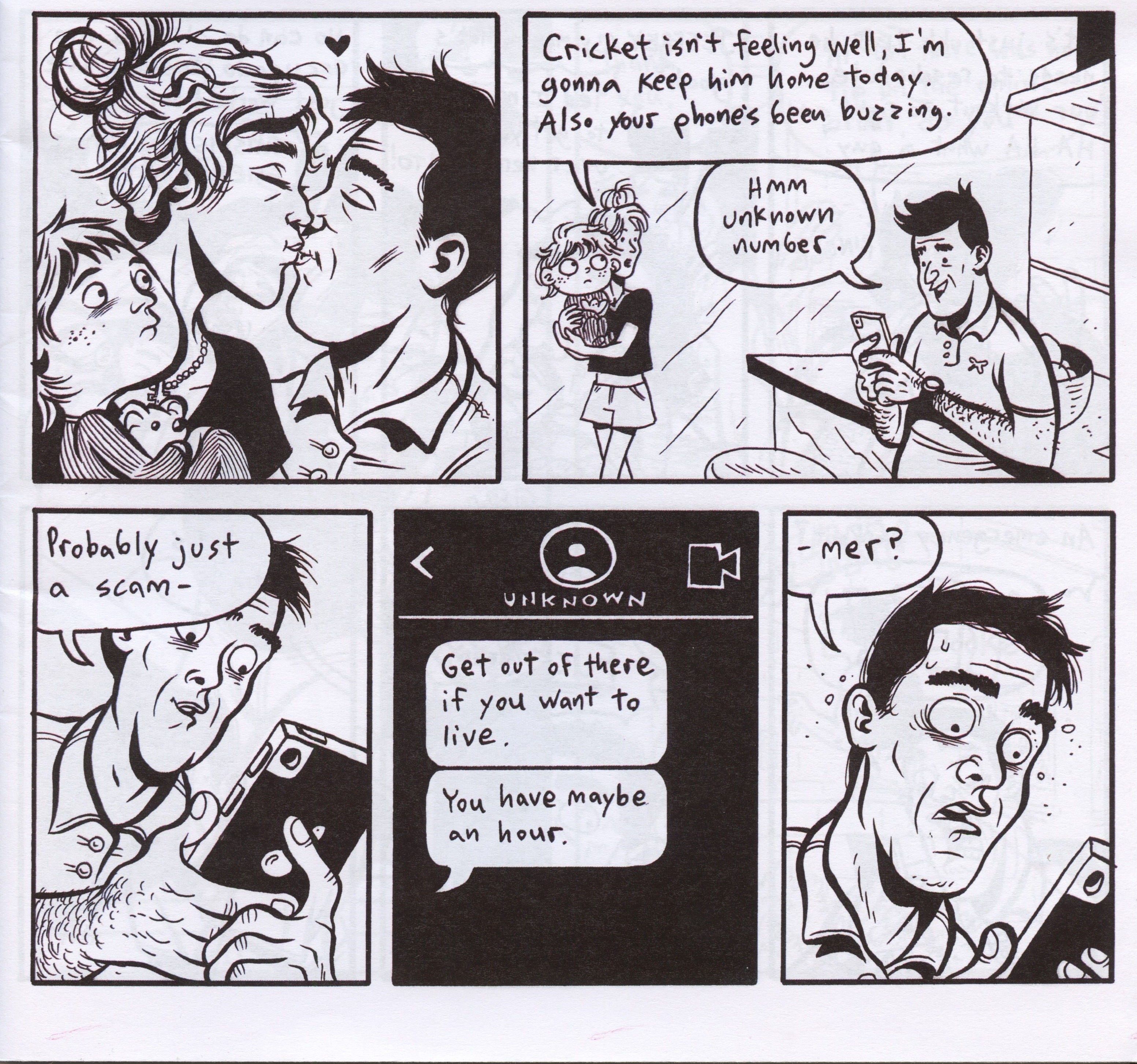
A few years ago film twitter, as loosely defined as a descriptor that is, debated the existence of a “good cell phone movie”, shortly after the release of Licorice Pizza. The conversation had begun when it was noted that Paul Thomas Anderson hadn’t directed a contemporaneous film since Punch, Drunk, Love. A number of users had identified texting as an obstacle for film to depict, arguing further that its filmic disruption discouraged the master behind The Master from engaging with modern settings. I can’t tell you if that’s the case for PTA, although the modern day setting of the upcoming One Battle After Another, will at least show us if he chooses to depict every conversation over phone calls rather than texts. I can say I have observed the disruptive nature of trying to put phone screens into a live-action production. When watching the all-silent episode of Only Murders in the Building, my mom had to stand next to the television in order to read the text bubble conversations.
Every medium has its limitations, but the transition here of Cavendish checking his phone, followed by a panel of the phone’s screen is incredibly clean. This is technically a “Subject-to-subject” transition as defined by Scott McCloud in Understanding Comics, but the panel being the screen itself, rather than Jeff holding his phone pushes that definition a little bit.
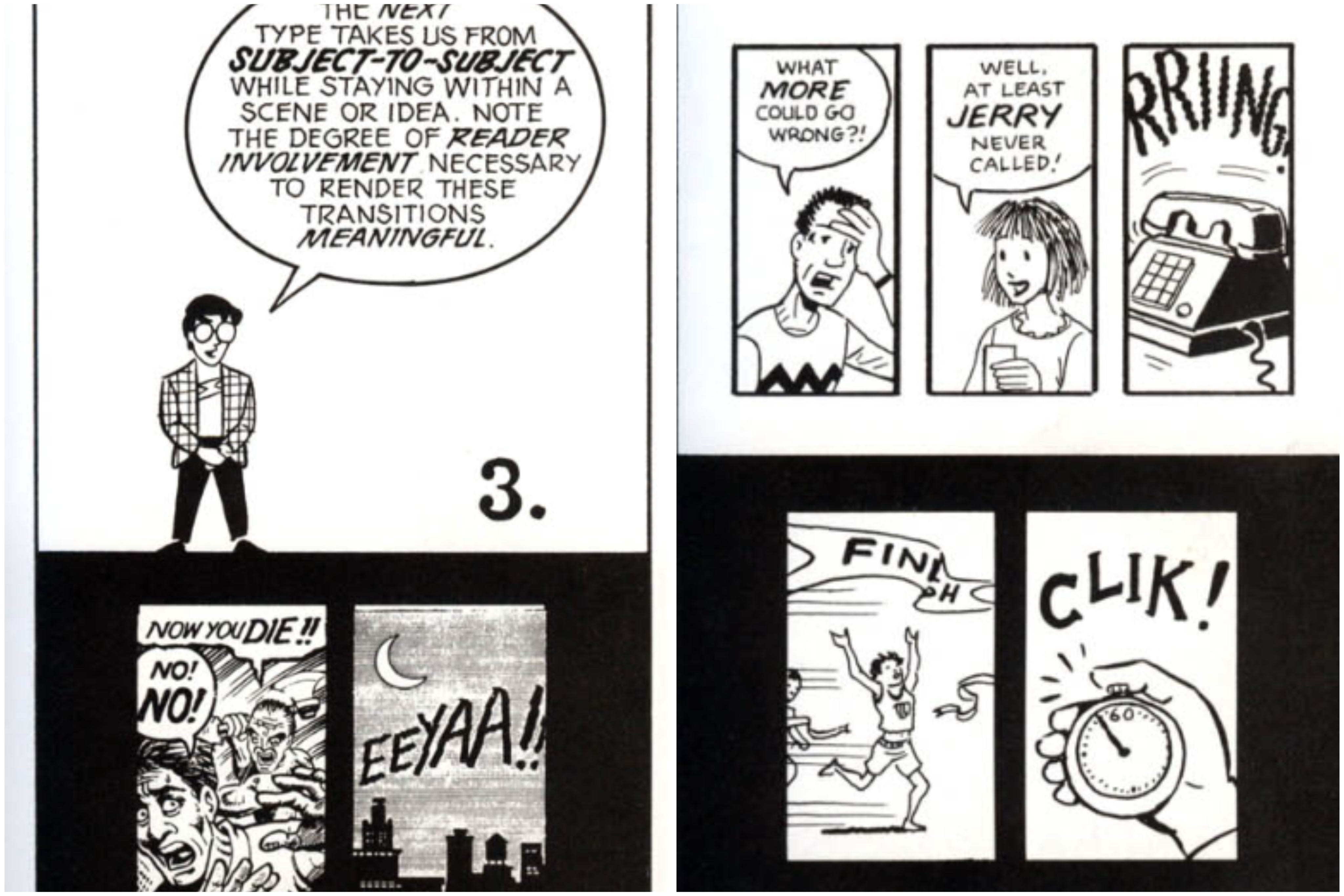
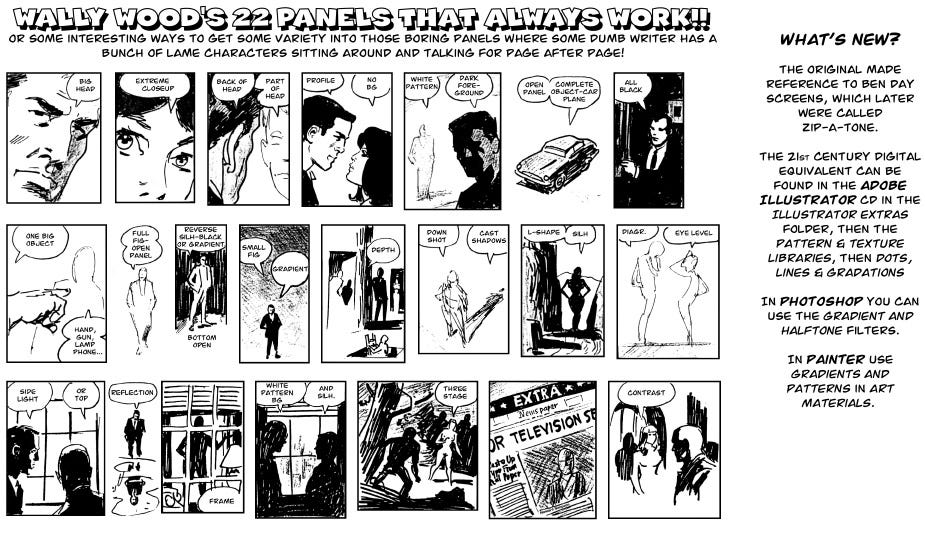
The interface of the phone, especially as we see UI for different apps later makes this feel as if it’s on the boundary of subject, aspect, and setting, if not it’s own category. This isn’t an invention here from Shea-Wright, it harkens back to panel 21 of Wally Wood’s 22 Panels that Always Work, that being the ‘Newspaper or Television Set’, but it’s a tool that he’s able to deploy neatly and frequently and this book just wouldn’t work without it.
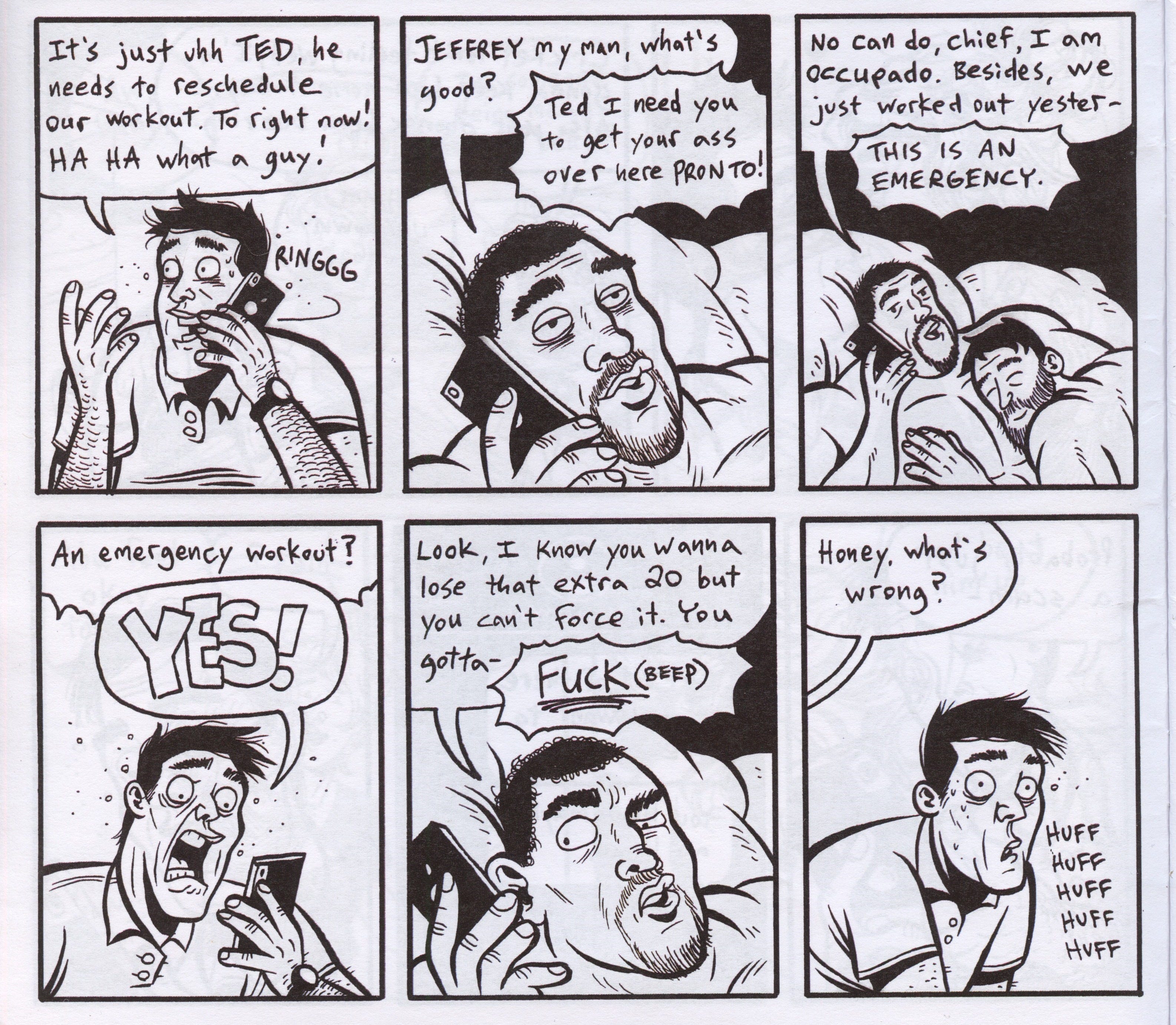
Jeffery begins panicking on the following page, desperately begging his regular trainer for an emergency work-out but the pleas are declined. Shea-Wright really pushes the facial acting in this sequence. Ted, Jeff’s regular trainer, is never shown with fully open eyes. He’s introduced with his top lids clearly visible, and the following panel zooms out so that his eyes are reduced to dots. This brief respite from Cavendish in total panic mode snaps the focus back onto the fear in the dinner-plate sized windows to his soul when he shouts ‘YES!’ in a state of total fear. With the offer rejected the scene ends with Jeffrey panting in exhaustion.
Enter our unlikely hero. An every-woman for the gig economy era, a food runner, student-loan-ower, insurance-needing, millenial, broad-shouldered ox of a woman. This is unfortunately where I have to identify what the biggest weakness of this issue is. Our co-lead is not named in this book. I read this thing like two ore three times, just looking for her name. As unfortunate as the absence of her identification is, her introduction is her character. A stream of HUFF’s trailing behind her as she races down the sidewalk of a residential neighborhood denote her endurance. The first of these exhales doesn’t even squeak fully into the panel. We’re not witnessing her afterburners engage here, this is momentum she carries in perpetuity. Even the way she rings the doorbell is done with urgency. All this strain and effort are quickly disregarded by her patron, who slams the door in the middle of our heroine preparing to grovel for a tip. As she taps away frustratedly on her phone, we’re presented with a stream of other gig-apps. Nitro*Nosh lets us know that her payout for the previous page was only $2.44, Insta Bring displays no requests for her, but Swole Patrol offers a glimmer of hope. JEFF_ROX69 offers her triple if she arrives in 15 minutes.
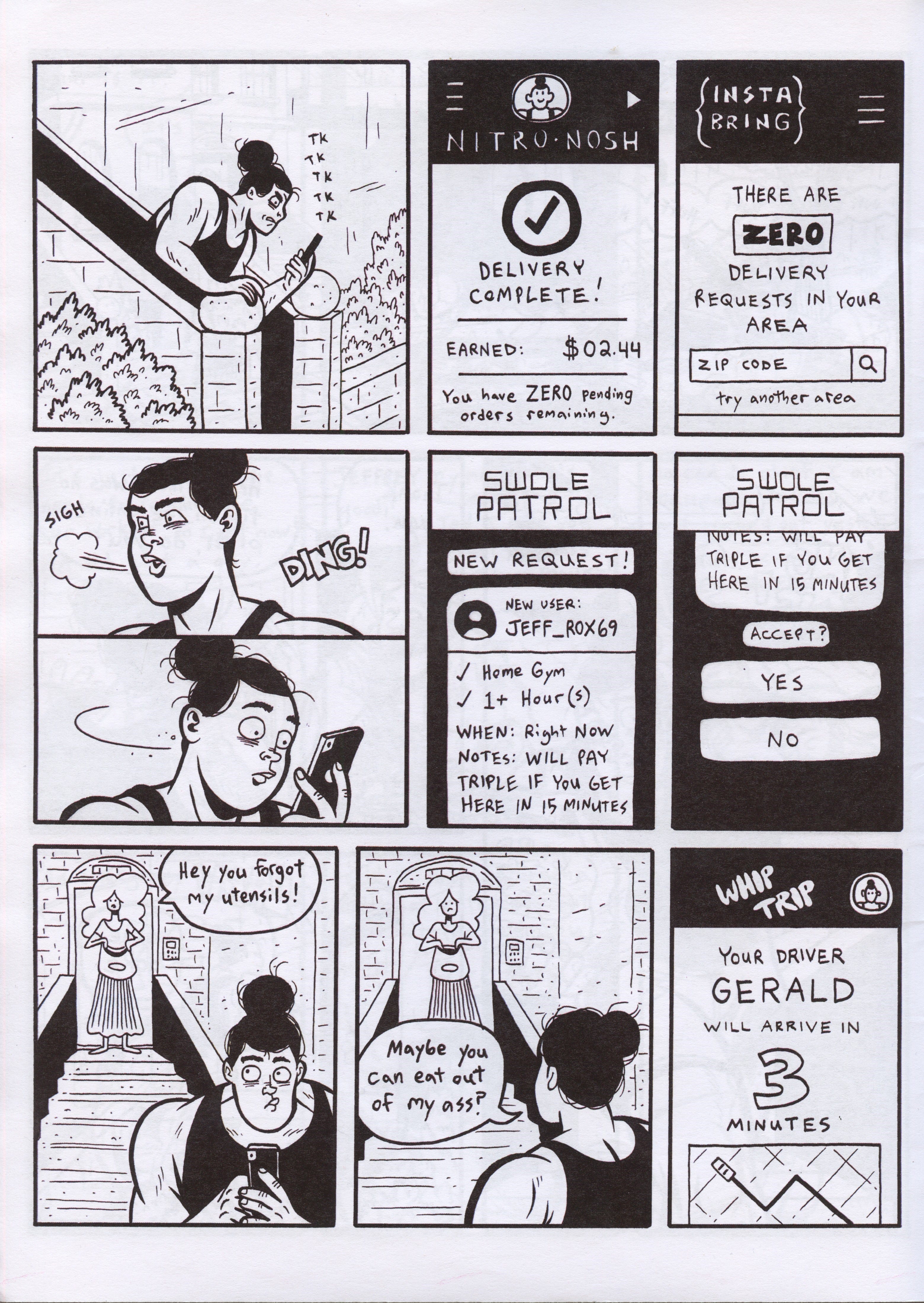
For as clear as the stakes are here, the disparity between the food delivery work and the potential of the workout job, I do have to ding Michael for not squeaking her username into any of these screens. I’m sorry, it feels like the organic way to do it. I’ll give him bonus points for all the distinct logos that the apps have, and the way the text, while clearly hand written, shifts in style to denote each tab, button, and text box within the individual programs. GERALD’s name appearing larger than than “your driver” in the final panel of the page, with the emboldened ‘3’ for the countdown breaks down the overlap between good cartooning and good design. There’s plenty of illustrators with incredible skills who don’t necessarily present information clearly. Jim Lee’s work demonstrates significant technical prowess but doesn’t have a kinetic flow and I promise I will break down a full issue of his soon since I keep using his work as an examples of weakness. Shea-Wright includes most of the visual information we need in every panel and it’s very pleasing to my eyes. The user interface of this comic, that being the delivery of story elements, is incredibly reader friendly.
The following page starts with yet another app screen and the most foreign conceptually to the reader, but because of the distillation I was just speaking about it’s instantly clear what its function is. 6FT, the hitman hiring app displays the number of heavies contracted, the amount of violence requested, and the payment. Hunter_77 and his buddy Dick Nose discuss the assignment between insults and sips of beer. These aren’t you’re Wildstorm or Extreme Studios era, ultra-kitted out assassins, or the suave torpedoes of the John Wick films. These are jackasses looking for cheap thrills that pay well. Their leisurely introduction contrasts them from our heroine in both motivation and ethos.
Cricket Cavendish plays on an iPad with a blank stare while his father desperately packs up cash to shoo the family out the door to relative safety. As I said before, I think the expressive close-up faces in this book are tremendous at showcasing the emotions of each character, but I also love when we’re presented with a smaller drawing of a character in shock where their eyes and mouth are reduced to just a dots and lines. It really sells a blank, shocked, stare in the middle of all the high running emotions. Jeff tries to put on a brave face, but practically as soon as his wife steps out the door he vomits, confirming that he is really a rich prick with soft hands who is way out of his depth. Gerard, the Whip Trip driver drops off the personal trainer outside the Cavendish’s residence, and she wishes him well on his upcoming exam.
We’re not clued into their conversation leading up to this, but it’s clearly done to flesh out her character as someone who wants to show appreciation for others dealt the same hand as her in life, as opposed to the Nitro*Nosh customer who slammed the door in her face four pages before this. The trainer speaks with the reception agent who receives frantic approval from Cavendish to let all his visitors up to his penthouse just as Dicknose, Hunter, and a third 6FT assassin arrive.
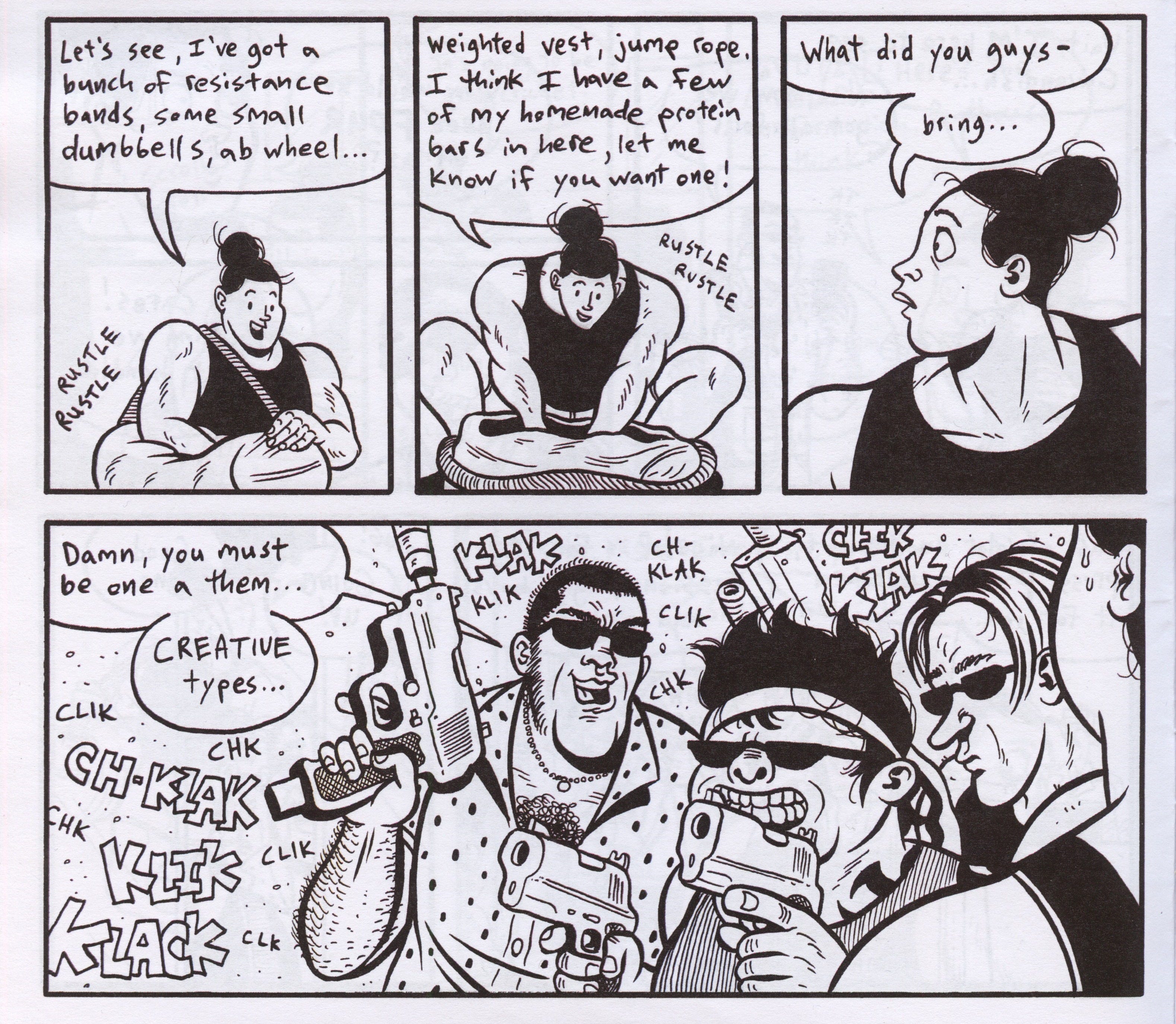
The trio mistake her for the fourth hired gun, and unease sets in in our heroine as the group boards the elevator. As the trainer shows off her workout equipment, the hitmen unveil their weapons and true panic sets in. God, back to the dot eyes. She looks so innocent and enthusiastic digging through the duffle bag to offer these freaks protein bars and it’s juxtaposed so damn well with the absolutely sinister grin on the face of the hired gun wearing a headband. As the elevator rises, so does the tension.
I like a good shootout in comics. Hardboiled, by Frank Miller and Geof Darrow is gonna get an article one of these days. Michael Shea-Wright isn’t anti-gunfight. There will be shooting in this comic but that’s not all there is. He expressed in an interview with TCJ online that he’s interested in the physicality and choreography of hand to hand combat.
It starts with just wanting to draw the body. I love action movies, and I watch a lot of action movies. I started to think about why do I love these things so much? I’m not an advocate for violence in general, I don’t like guns in real life. I just think a lot about why these things are so appealing. I started to think about what action movies I find the coolest, and it’s all choreography. I love fight choreography and I love hand-to-hand or knife stuff that doesn’t involve guns at all. - An Interview with Michael Shea-Wright by Brian Nicholson
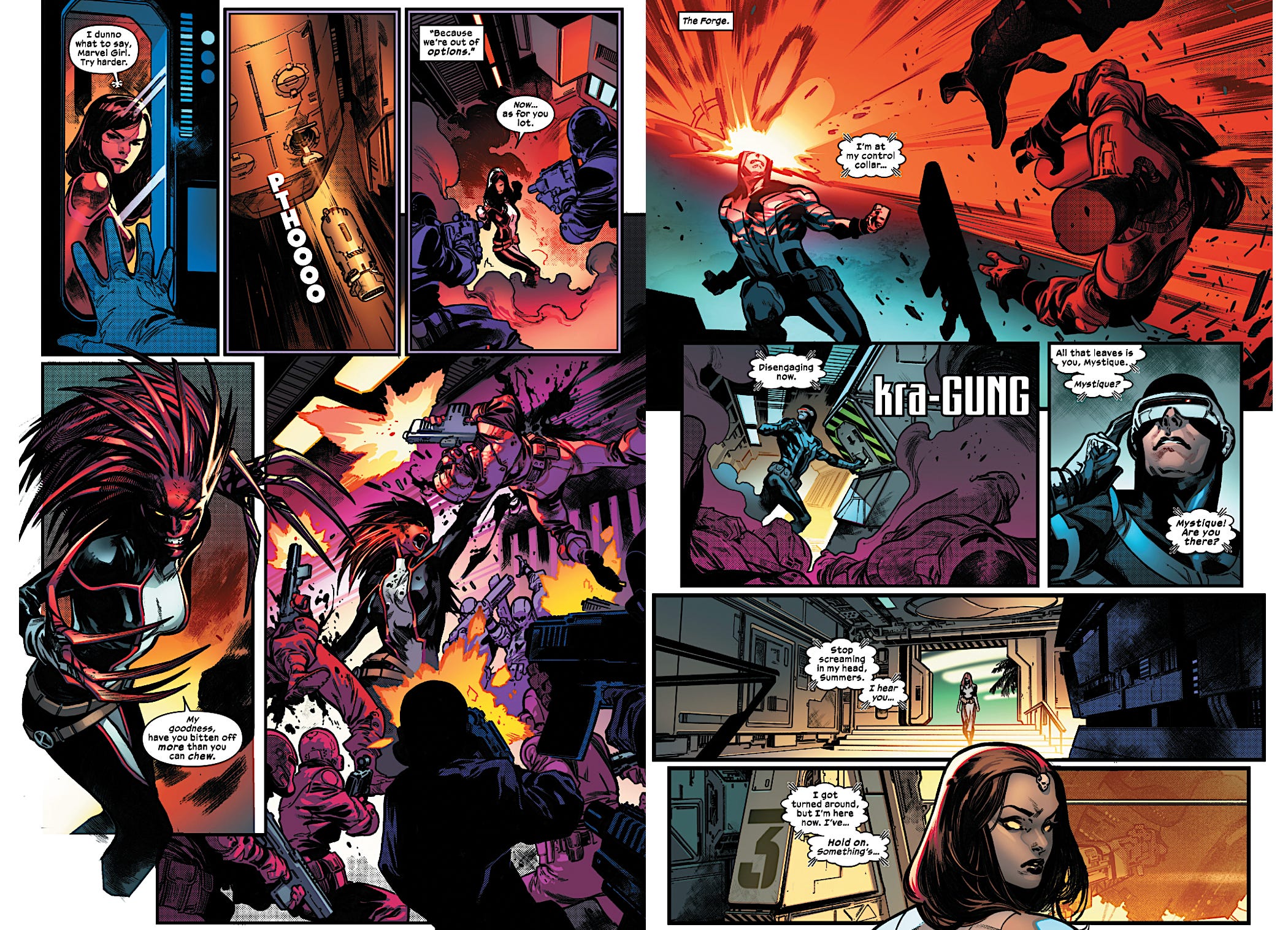
In comic called ATP, what else would you expect? We’re less than halfway into this book and the action erupts. In a broad swooping movement, the trainer bundles the would-be assassins up with her jump-rope, stuffs the handle in Hunter’s mouth and dives backwards out of the elevator as the unnamed gunner unleashes a spray of bullets. I’ve read a lot of super-hero comics, and in some of the more lauded ones, I’ve seen some pretty shitty action sequences. House of X in particular features some narratively intense standoffs that, for my taste, lack kinetic energy.
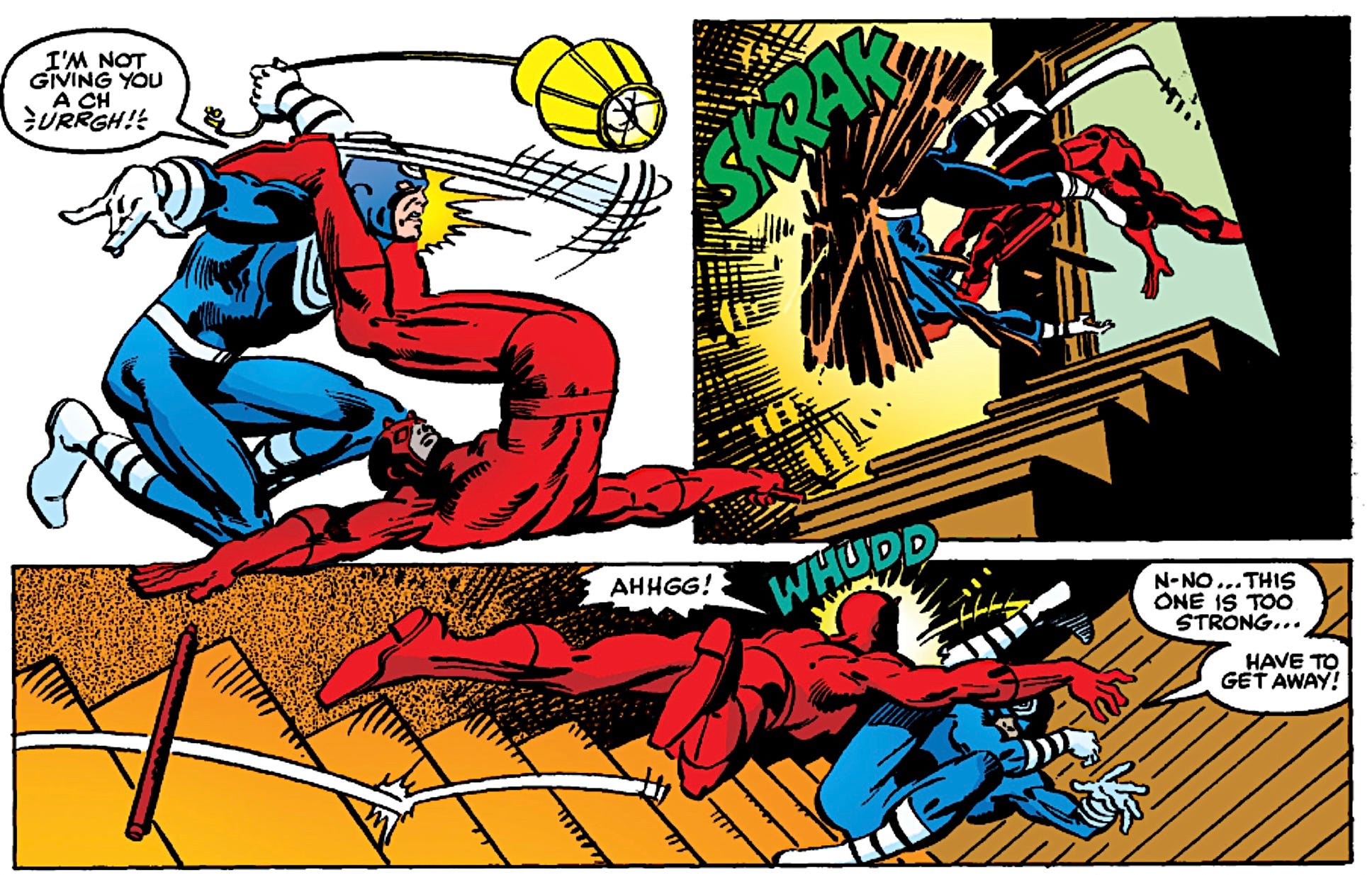
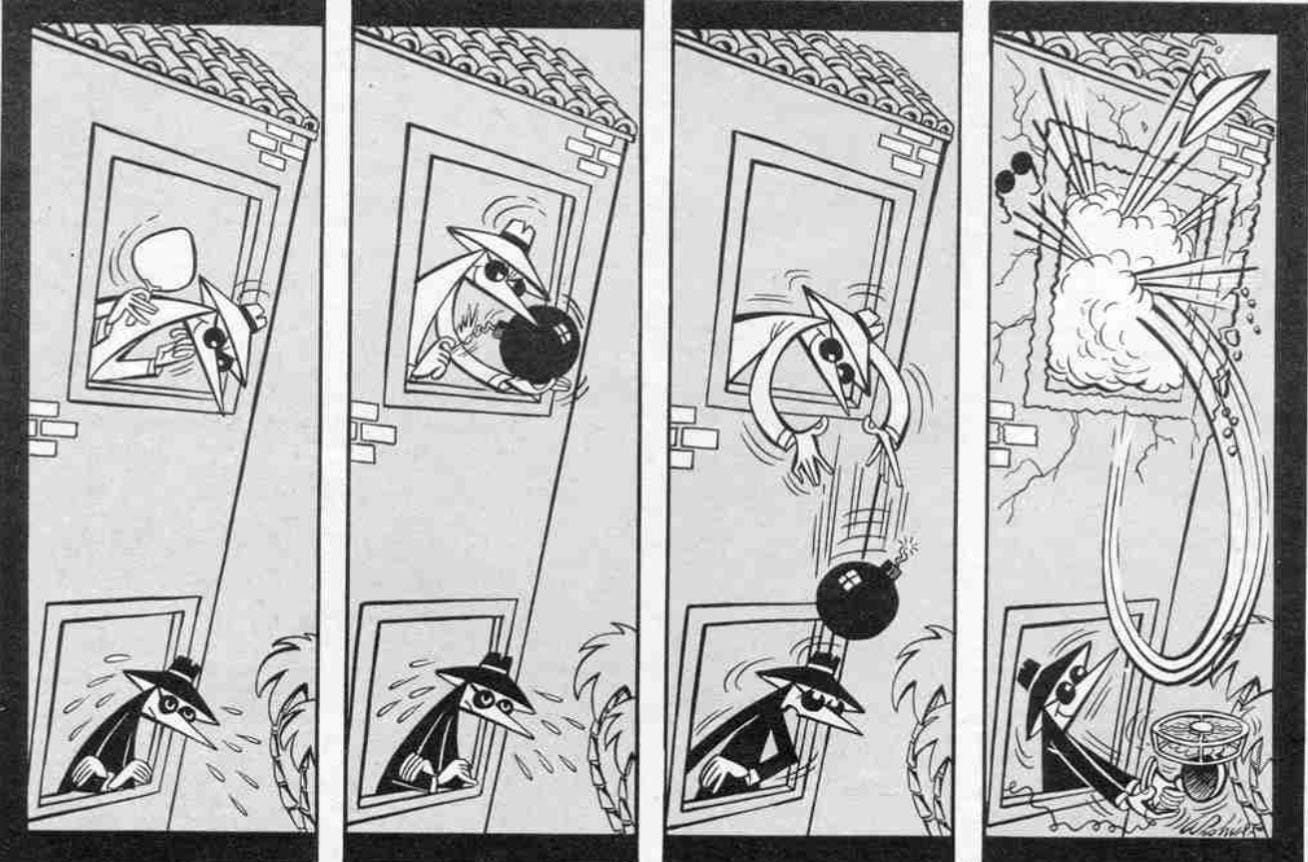
ATP’s fight choreography displays the force and follow through of a fight scene from Frank Miller’s Daredevil with the outrageousness ingenuity of Antonio Prohias’ Spy vs Spy strips.
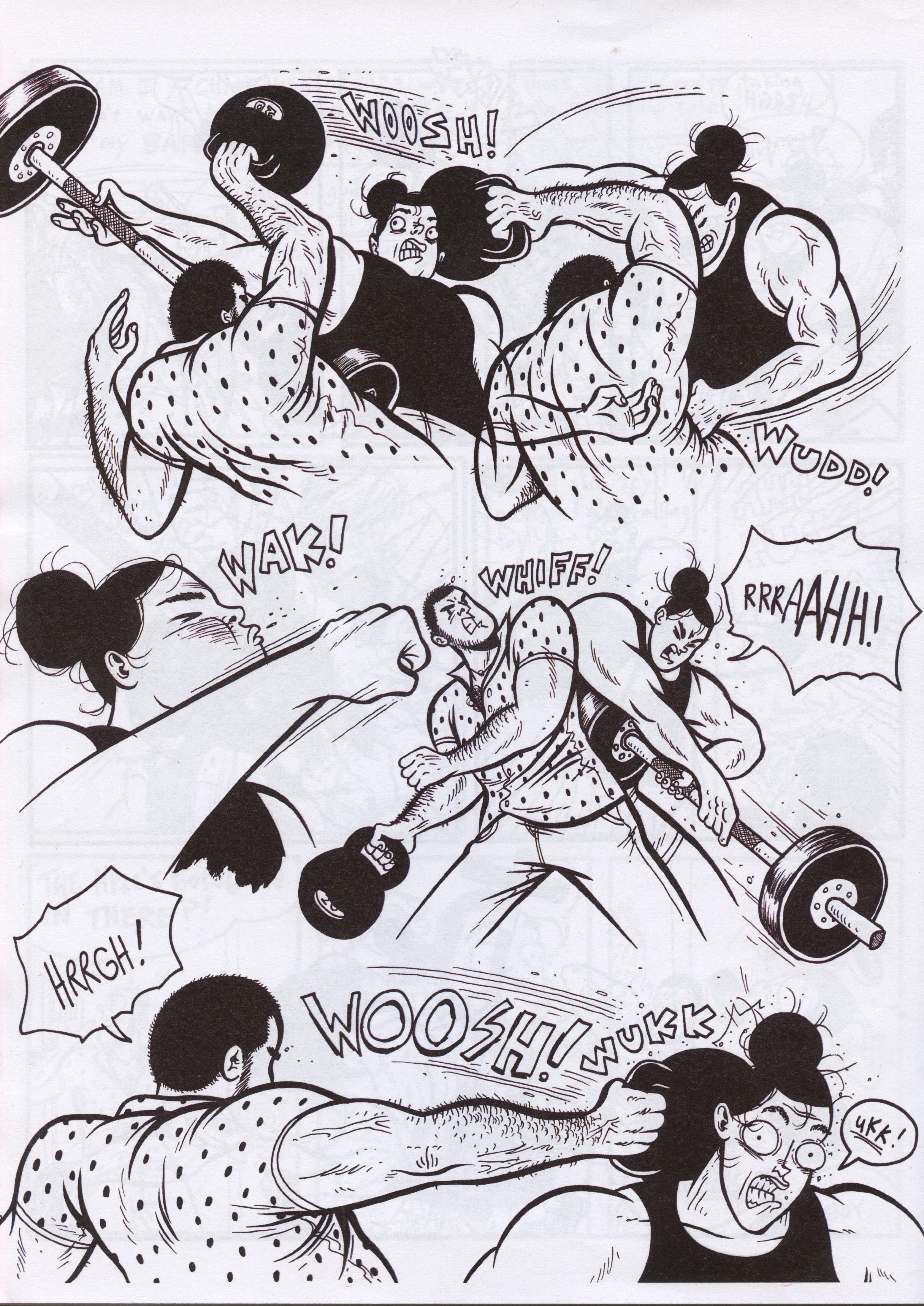
Characters’ legs buckle under the weight of the workout equipment they swing at each other. Panel borders disappear for a few pages, to accentuate the freneticism of this encounter. Sound effects are squashed and stretched between swinging fists to indicate near misses, or hard impacts. The back and forth I love of dot eyes followed by bugged-out balloon eyes sells the major disorientation that would come from dodging a punch just in time for a kettle bell to smack your skull.
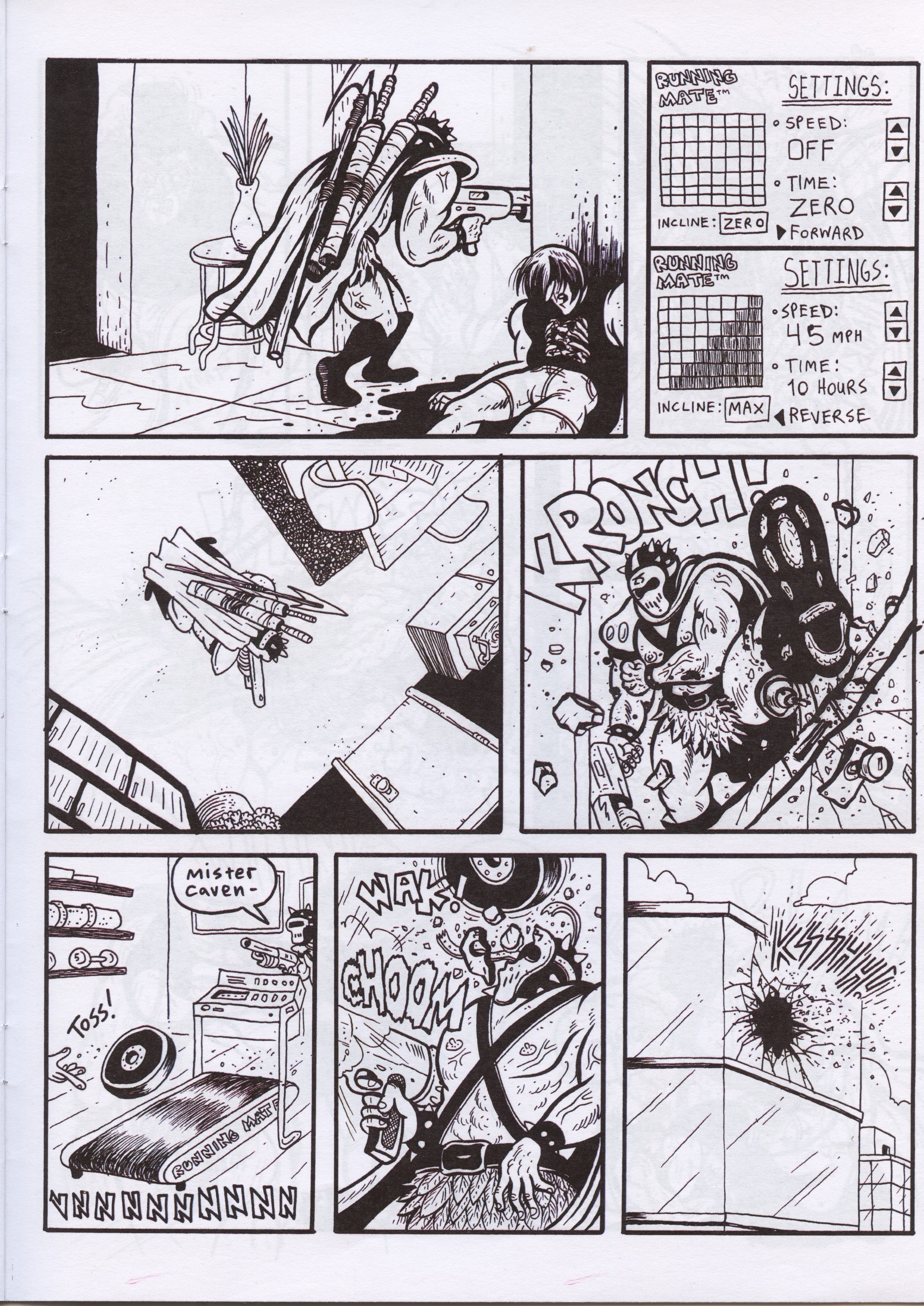
In the midst of all this chaos, the real fourth assassin, enters the fray. His design is the most outlandish yet. If DC was considering arranging a crossover between Absolute Batman and the Teenage Mutant Ninja Turtles I’d have to imagine Freddie Williams III or Nick Dragotta would be taking some notes from ATP for Absolute Shredder. His arrival is also perfectly timed. Just as the trainer gained the upper hand over Hunter, here comes some mean Mad Max looking son of a bitch to raise the stakes. Assassin four creeps through the penthouse after blasting Dicknose’s guts out, just as we see the control panel for a treadmill shoot up from zero to forty-five miles per hour. He kicks down the door to the penthouse’s home gym just in time to get pelted by barbell plates launched off the Running Mate’s conveyor belt.
With his armor damaged and his gun destroyed the trainer takes this advantage to engage the barbarian in hand to hand combat. The pair grapple and flip positions. Furniture is smashed, but eventually the hitman gets our gal in a choke hold. Cavendish shoots the killer in the arm, and the leading lady catches the stray through her hand first. The pain is enough for her to break out of his grip, and eventually bring him to the floor.
The not so dynamic duo of Cavendish and his temporary employee question the bruiser at gunpoint, but the confidentiality of the app prevents him from giving them clear answers. Hunter stirs from his concussed state and bemoans the death of Dicknose. The Road-Warrior reject tries to express regret, but it only enrages Hunter who puts a bullet between his eyes. Jeff seizes the opportunity to do the same to Hunter, leaving only two standing. Miss ATP, as I’ll call her to avoid some repetition, wraps up her bleeding hand, and tries to do the same with her gig work but Jeffery uses his pull to rope her in to keep defending him. She tries to reject his offer, but the promise of paid student loans as well as a measly hundred dollars up-front for the “workout session” they just completed, seals the deal. Cavendish dubs the last assailant ‘Conan’ and picks up his cracked phone from the rubble to search for evidence.
On the final page a smartwatch receives an update confirming the Jefferey not only survived the onslaught, but that all his ducking and shooting helped him meet his step goal for the day. Torsos in business clothing, sipping whiskey from short glasses, bemoan the failure of Plan A and debate Plan B’s viability with a third party. In a strange callback to our Hellboy article, the story of this comic ends with a Misses Cavendish, drink in her hands and mysterious motives in her mind, discussing peril for our lead characters with figures enwrapped in shadow. One solitary panel on the following page, shows the now orphaned cat of Dicknose and Hunter waiting by an empty bowl, potentially another casualty of the 6Foot shootout.
ATP has 36 story pages, twelve more than a standard first issue, so that does give it a bit of an advantage when stacking it up against a regular comic, but it’s not a graphic novella. I don’t think there’s a single wasted page. Every panel is brimming with life. The geography of the penthouse is intuitive, and the sequences where the backgrounds drop out aren’t done to cut corners, but to accentuate the momentum of the bodies flung to and fro. The remaining four pages, and the back cover are used to disseminate process information. It feels like a post workout cool down to help the reader reaccustom themselves to their less strenuous reading environment. I love this.
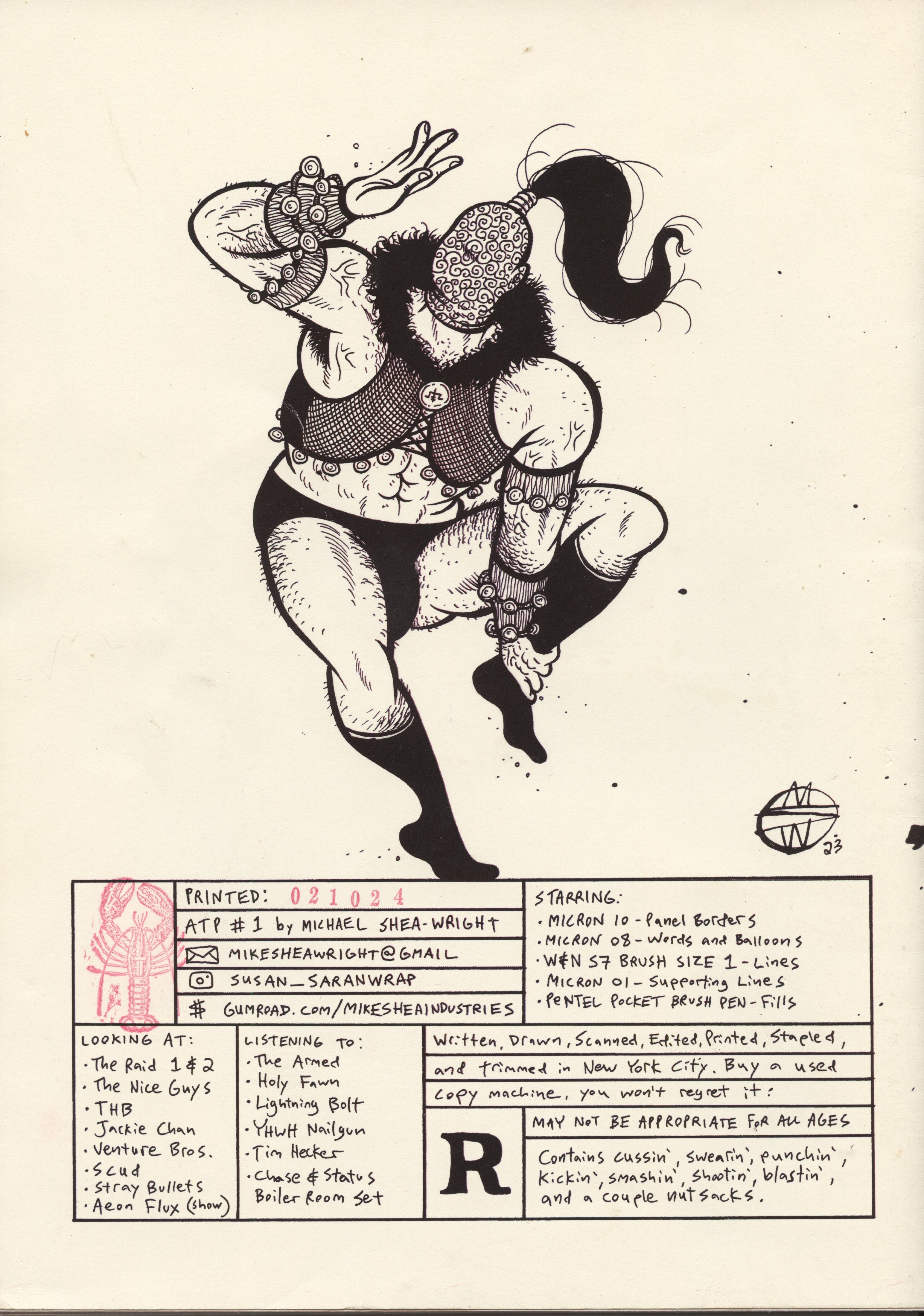
The back cover includes a drawing that I think, after watching Mike free hand draw some pages with Nick Forker, creator of Eyeland, and Mike’s partner in crime on their youtube channel Comics People, may just be something that Shea-Wright threw down on the paper purely from his id. Below this strange, masked figure, Shea-Wright lists the tools he drew this comic with, his print production method, a list of inspirations, and a reader discretion rating.
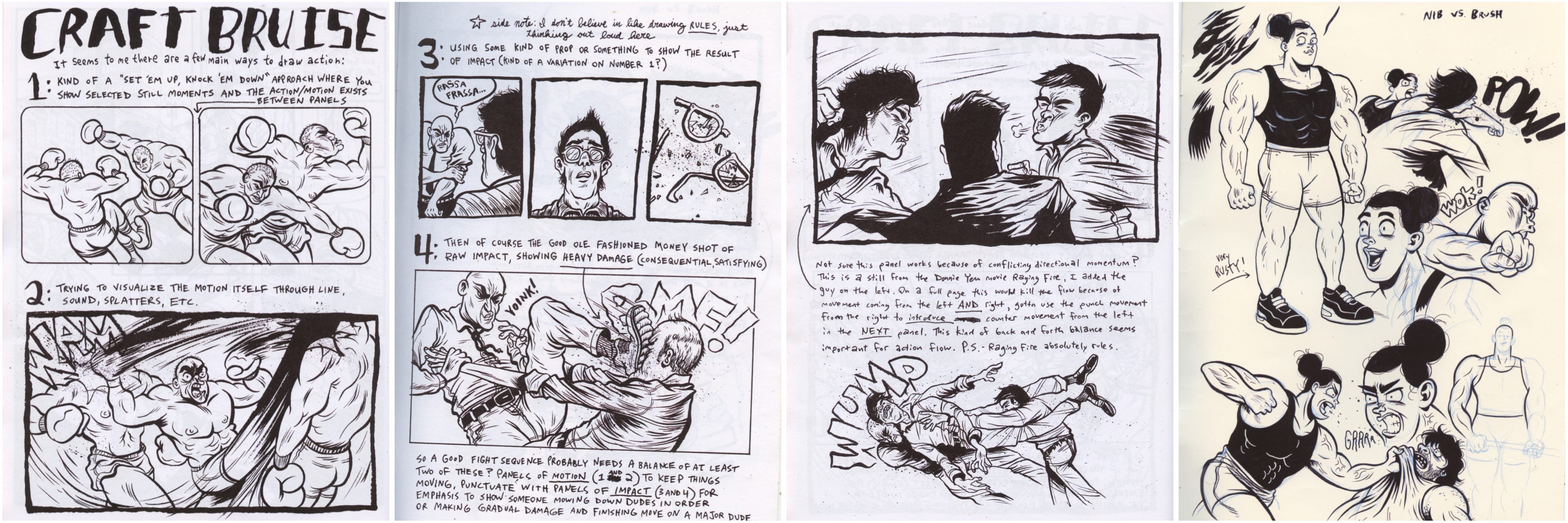
This comic is about work, the cruddy jobs that people have these days and the actual effort required to make a comic. That said it’s less of a challenge to the reader and more of an encouragement to try and walk that path yourself. Without making Making Comics, the Scott McCloud instructional graphic novel, Shea-Wright lays bare his methods of construction. Warm-up sketches, framing and storytelling devices and tools of the trade are made explicit to the reader. Additionally this serves as a declaration that, like Chris Burden, Shea-Wright is the work that he produced. Every song on his playlist every comic he read and movie he watched all have a place in him and what he makes.
This comic’s feat of clay sensibilities, define it in opposition to the digital patheticism that mires the current cultural landscape. Without being explicitly didactic, I don’t know how you can read this book without feeling like you have to participate not only in comics, but in your life. The Cavendishes put prices on people’s heads, whether it’s Jeffrey summing his trainor’s life up as freedom from her debt, or the payout his wife offered the operatives from 6FT to dispatch her husband. They are the cruel and criminal. Fry your own chicken, run your own races, print your own comics, and when you need help, by God, show some gratitude to the person who offered it. When you know how to take care of yourself it’ll make it that much easier to extend a hand to someone else in need. This is the work that should not and cannot be regulated by algorithms. And yeah, I need to be better at all of this too.
Paul Pope is an artist I expected to talk more about, hence this article’s opening quote. Shea-Wright’s brush inking certainly shares a similarity to Pope’s especially when it comes to rendering sweat-wetted hair. That said I think what Shea-Wright has learned most from Pope, is the ability to make his characters truly act, which is also learned from just being good at observing people. There’s also a certain ethos they share which is the inclination to speak to the reader beyond the page. The Image Comics edition of The One Trick Rip-Off + Deep Cuts includes practice pages for the comic itself.
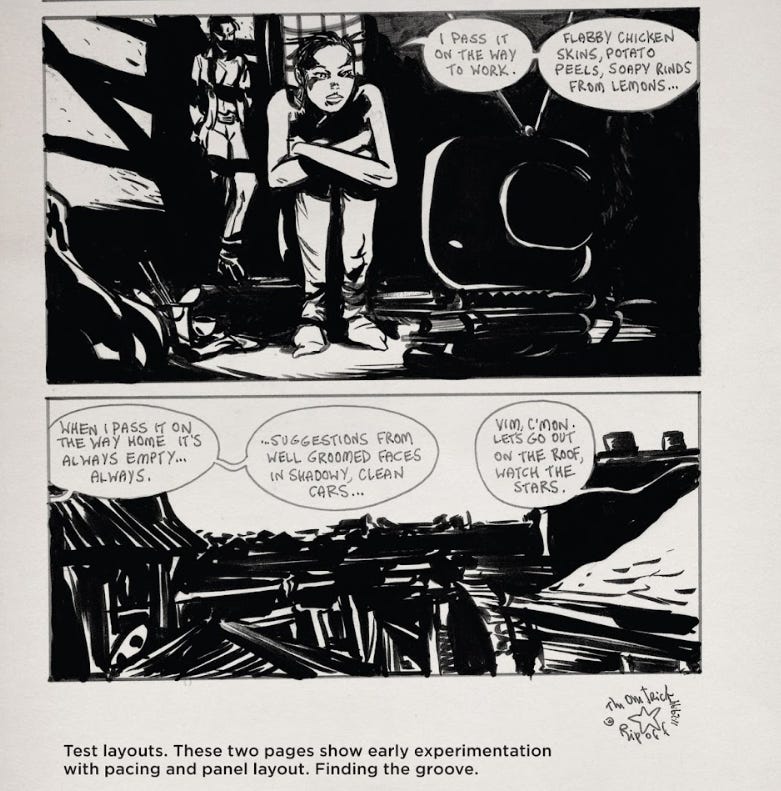
Again, I like the inclusion of the baby steps it takes to get the comic moving, although maybe ‘baby steps’ is the wrong term since you should probably call a museum if your toddler can draw like any of the artists listed in this article. Shea-Wright’s inclusion of his process work, whether consciously an homage to Pope or not is one of the more significant elements of this book to me. I have to imagine the title, ATP, is also a slight homage to THB, one of the influential works listed on the back cover, which is also the acronym for a molecular compound, albeit fictional. For all the similarities that can be observed in craft and creativity, I see Mike, definitively, as his own guy. This designation, in my mind, was not lessened, by speaking with him recently at Brooklyn Independent Comics Showcase and seeing that he and his tablemate, the aforementioned Nick Forker, are at the show to sell (and draw, when their table isn’t busy?!??) comics, in a space crowded with pins and posters.
Okay, so it isn’t April, it’s May. I think I should be able to deliver on the promise of an early June article. I had a few shows, holidays, and a grant to submit that I’m going to pretend delayed this review before I admit that I pathetically wasted a day of my life playing an Alien RPG Phone game when I had a perfectly free Sunday. Fear not, the shame of such an act has prevented me from enjoying the already lackluster gameplay, but I have to admit, I was sucked in by seeing the ad on instagram every day.
I’m thinking for the next article it might be time to sharpen the knives and carve up everything I don’t want from a first issue. Once again, thank you all for reading.